3 Days in England

We had MLK day off, so we added a day of PTO to give ourselves a 4 day weekend. Due to the long travel time, (10 hours each way) we ended up with 3 days to explore. On this trip we visited some iconic locations like Big Ben, Buckingham Palace, and the National Gallery. But the highlights were tours of Stonehenge and a nearly 1,700 year old Roman bath house.


Trip time: 4 days: 1 PTO day + 1 vacation day (MLK) + 2 weekend days – 10 hours each direction.


Major attractions visited:

  • Buckingham Palace
  • Westminster Abbey
  • Big Ben & Parliament Square
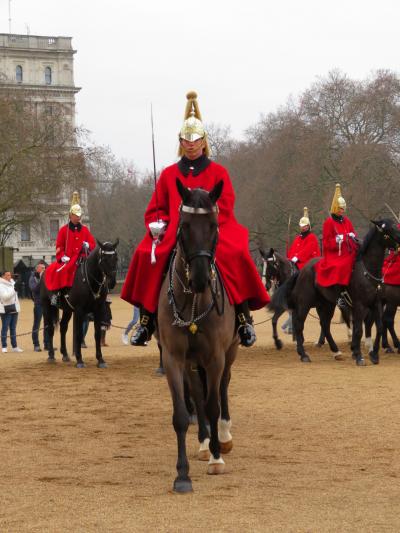
  • Household Cavalry – Changing of the Queen’s life guard
  • Trafalgar Square
  • National Gallery, London with Leonardo da Vinci, Raphael, Michelangelo special exhibit
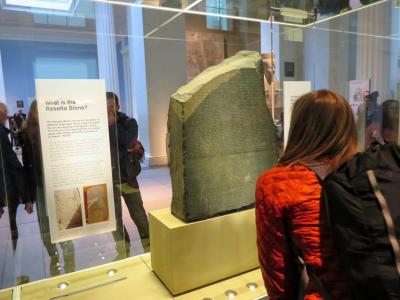
  • The British Museum – home of the Rosetta Stone.
  • London Tower
  • Tower Bridge
  • London Bridge (It’s just a bridge, and not currently falling down)
  • All Hallows Church (The oldest church in London, est. 675)
  • Hampton Court Palace, home of King Henry VIII
  • Stonehenge
  • Roman Baths at Bath


Cost

Cost per person: Total $815
Air travel: $529
Local Transport (Train, Subway): $76
Bus Tour (Stonehenge, Hampton ct palace, Bath) $140
Room (Airbnb Private room) $70


Other Costs
Food $0-$50 per meal
Parking at home airport $42 total (LAX lot c)


A self-guided walking tour through the heart of London, from Victoria Station to Parliament Square.
This is part 2/3 of our walking tour of London, heading from Parliament Square to Trafalgar Square.
sfasadsf d f ds asdf asdf asdfa d
We decided to pop in to the National Gallery while we were in Trafalgar Square.
The British Museum: "It's just a bunch of stuff that's been nicked from other countries."
The London Wall, The London Tower, Tower Bridge, London Bridge, and All Hallows By The Tower
England is not a cheap vacation destination by any stretch of the imagination. We did figure out one good trick
Most everything about the former home of King Henry VIII was creepy, unwelcoming, and a little bit off.
Walk centuries old stone streets, enjoy beautiful 18th century golden limestone architecture, and explore a 2000-year-old Roman bath house.
I was probably pretty annoying the entire day because of my barely contained excitement.
Welcome to London! Walking Tour – Part I

We planned this walking tour with the help of British friends, colleagues, and the internet, and believe it is an awesome way to see some of the highlights of the city. We began at Victoria Station, which is the terminus of the Gatwick Express, straight out of the airport. Our flight was unfortunately delayed by several hours on our way to London so we started the itinerary on one day, jumped on the tube and went to our Airbnb to sleep, and started the next day at the same tube stop to continue our tour. We also didn’t go inside several of the historic buildings because we had limited time. The beauty of planning an itinerary like this is that it is entirely self-paced (and free). If you wanted to use this route, you could break it up into as many segments as you like and take as long as you want for each stop.

Parts 1 and 2 of our walking tour of London. Part 3 will require a tube ride and separate map. For a live map of this leg of the trip, click here.


Stop 1: Buckingham Palace

Buckingham Palace is the Queen's weekday home, which she refers to as her office. Her back yard consists of heavily guarded gardens with barbed wire and electric fences reminiscent of Jurassic park. Her front yard is basically London.
Buckingham Palace is the Queen’s weekday home, which she refers to as her office. Her back yard consists of heavily guarded gardens with barbed wire and electric fences reminiscent of Jurassic park. Her front yard is basically London.


Stop 2: A Monument to Queen Victoria

This is a monument to Queen Victoria, presented in 1924 by sculptor Thomas Brock. It's almost unfair to call this a stop because it's right across from Buckingham Palace and it's basically the queen's front lawn ornament. Some people have garden gnomes, and some people have multi-story marble and gold statues, I guess. She is among the richest women in the world, after all. (Fun fact: she also owns all of the unmarked white swans in the UK.)
This is a monument to Queen Victoria, presented in 1924 by sculptor Thomas Brock. It’s almost unfair to call this a stop because it’s right across from Buckingham Palace and it’s basically the queen’s front lawn ornament. Some people have garden gnomes, and some people have multi-story marble and gold statues, I guess. She is among the richest women in the world, after all. (Fun fact: she also owns all of the unmarked white swans in the UK.)


Stop 3: Westminster Abbey

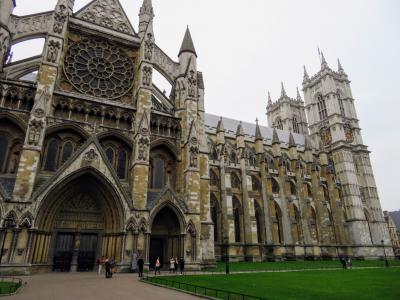
The history of Westminster Abbey dates back to 960 AD and the construction of the building you see here began in 1245 AD. It is the site of royal coronations, weddings, burials and memorials.


The attention to detail on every surface of this building was overwhelming. Josh was especially taken with the wood and metal, highly ornate door.


This was my favorite shot of the church. The Abbey charges for admission and sees over 1,000,000 visitors a year, with peak season being the summer. Note the lack of crowds in January.


 Stop 4: Parliament Square

Parliament Square is gorgeous. In addition to typical government buildings, it is full of giant statues of important historical British figures including Winston Churchill, Mahatma Gandhi, Nelson Mandela, and Abraham Lincoln. Wait... what? Well, they're all there anyway. It would also be the best view of Big Ben, were it not under scaffolding for restoration at the time we visited.
Parliament Square is gorgeous. In addition to typical government buildings, it is full of giant statues of important historical British figures including Winston Churchill, Mahatma Gandhi, Nelson Mandela, and Abraham Lincoln. Wait… what? Well, they’re all there anyway. It would also be the best view of Big Ben, were it not under scaffolding for restoration at the time we visited.


The presence of both Mahatma Gandhi and Winston Churchill on the same square was striking, considering that their views on Indian independence vehemently opposed one another. According to Wikipedia, Churchill famously once called Gandhi "a seditious Middle Temple lawyer, now posing as a fakir of a type well known in the East, striding half-naked up the steps of the Vice-regal palace". He stands here next to Nelson Mandela, (not pictured).
The presence of both Mahatma Gandhi and Winston Churchill on the same square was striking, considering that their views on Indian independence vehemently opposed one another. According to Wikipedia, Churchill famously once called Gandhi “a seditious Middle Temple lawyer, now posing as a fakir of a type well known in the East, striding half-naked up the steps of the Vice-regal palace”. He stands here next to Nelson Mandela, (not pictured).


Stop 5: Feeling Peckish

If you're feeling famished or fancy a pint, consider stopping in at the Red Lion or Fuller's Pie and Ale House, right off Parliament Square. It was the most expensive food we ate in the UK but quintessentially British.
If you’re feeling famished or fancy a pint, consider stopping in at the Red Lion or Fuller’s Pie and Ale House, right off Parliament Square. It was the most expensive food we ate in the UK but quintessentially British.


The pies were slightly better than average meat-and-pastry-themed foodstuffs and I wasn't impressed with the beer. The tea, however, was fantastic.
The pies were slightly better than average meat-and-pastry-themed foodstuffs and I wasn’t impressed with the beer. The tea, however, was fantastic.


It’s time for a tea break, but the tour doesn’t stop here!

Stay tuned for Part 2.

London Walking Tour – Part II

This is part 2/3 of our walking tour of London. For a live map, click here.


This post is a continuation of our London walking tour, featured in red in the map above. If you would like to start at Part I, click here.

Stop 6: 10 Downing Street

10 Downing Street is the headquarters of the UK government and where the Prime Minister lives. I had visions of spying on the building I knew and loved from watching Love Actually on loop from 2003-2007. Unfortunately, we were disappointed. The road was gated and guarded with by heavily armed men and there wasn't much to be seen.
10 Downing Street is the headquarters of the UK government and where the Prime Minister lives. I had visions of spying on the building I knew and loved from watching Love Actually on loop from 2003-2007. Unfortunately, we were disappointed. The road was gated and guarded with by heavily armed men and there wasn’t much to be seen.


Stop 7: Women of WWII Memorial

The Women of WWII monument features clothing from roles that women played during the war, including military uniforms, a nursing cape, and a welding mask. Josh and I puzzled over why these women were represented with empty clothes. Fortunately, Baroness Boothroyd, patron of the Women of WWII trust (who donated the money she won on Who Wants to Be a Millionaire to build this monument), and former Speaker of the House of Commons, had an answer: "This monument is dedicated to all the women who served our country and to the cause of freedom, in uniform and on the home front. I hope that future generations who pass this way will ask themselves: 'what sort of women were they?' and look at our history for the answer." (Wikipedia). Fun fact: 5 different types of helicopters did flybys during the dedication ceremony for this memorial, all piloted by women.
The Women of WWII monument features clothing from roles that women played during the war, including military uniforms, a nursing cape, and a welding mask. Josh and I puzzled over why these women were represented with empty clothes. Fortunately, Baroness Boothroyd, patron of the Women of WWII trust (who donated the money she won on Who Wants to Be a Millionaire to build this monument), and former Speaker of the House of Commons, had an answer: “This monument is dedicated to all the women who served our country and to the cause of freedom, in uniform and on the home front. I hope that future generations who pass this way will ask themselves: ‘what sort of women were they?’ and look at our history for the answer.” (Wikipedia). Fun fact: 5 different types of helicopters did flybys during the dedication ceremony for this memorial, all piloted by women.


Stop 8: Cavalry Museum and Horse Guards

This is a member of the Queen's ceremonial guard. We didn't take any funny photos... just look at this guy! He had a sword! Ironically, (and nonsenically), he was much scarier-looking than the guy just down the street with an automatic rifle.
This is a member of the Queen’s ceremonial guard. We didn’t take any funny photos… just look at this guy! He had a sword! Ironically, (and nonsenically), he was much scarier-looking than the guy just down the street with an automatic rifle.


We happened to be in the right place at the right time (Horse Parade Ground at 11am) to catch the changing of the Queen's Life Guard. It was one of those "I wonder what those people are looking at?" moments that really paid off! Enjoy the video of a piece of the ceremony.
We happened to be in the right place at the right time (Horse Parade Ground at 11am) to catch the changing of the Queen’s Life Guard. It was one of those “I wonder what those people are looking at?” moments that really paid off! Enjoy the video of a piece of the ceremony.


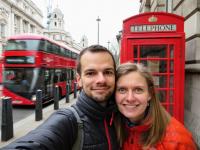
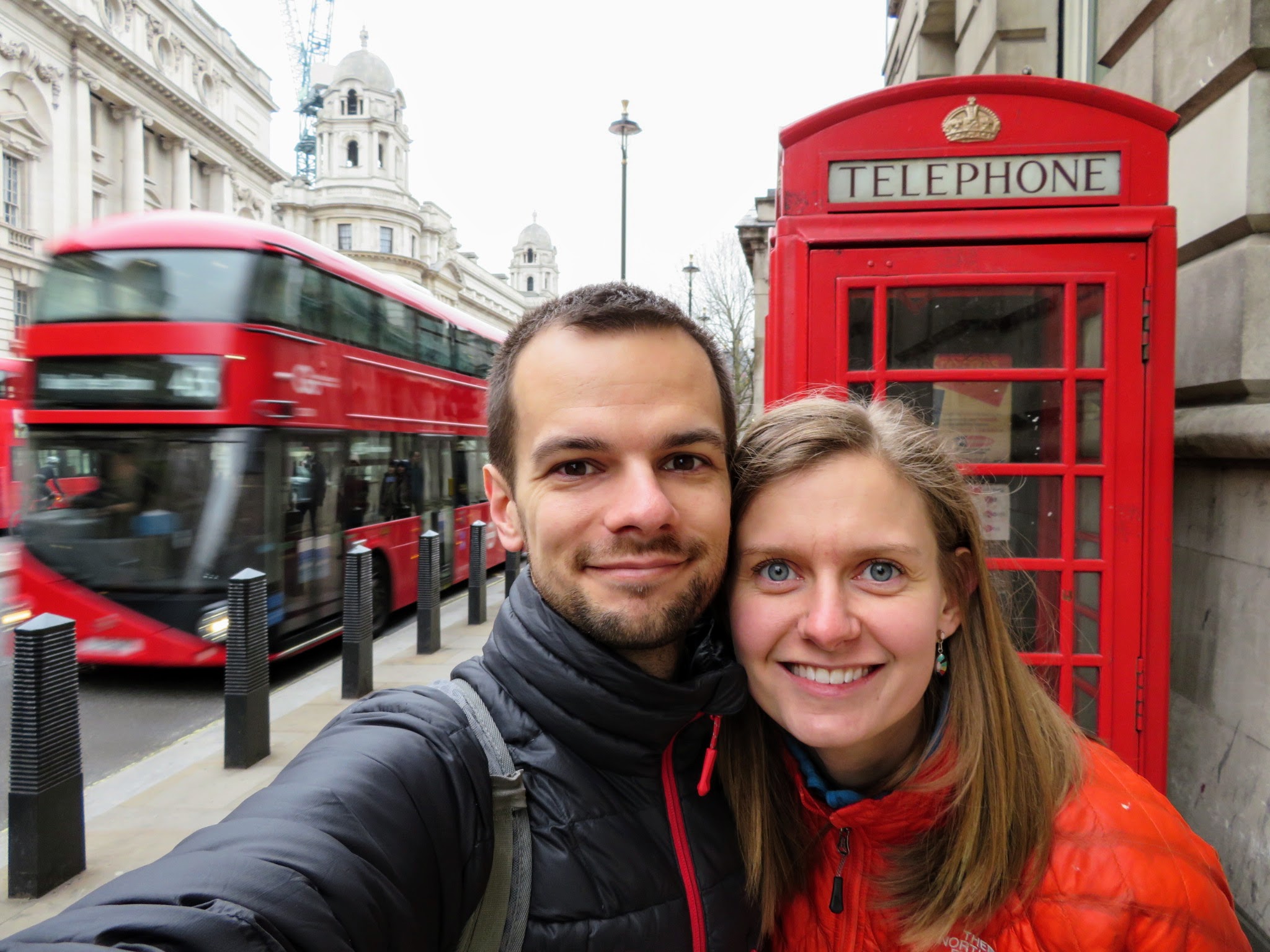
Stop 9: Obligatory touristy photo with a telephone booth

London has this way of gracefully blending the modern with the historical. For example, many of these telephone booths are now wifi hotspots. When we were taking this photo, a local yelled "Call the queen!". But I just laughed and waved because I don't know Bey's number.
London has this way of gracefully blending the modern with the historical. For example, many of these telephone booths are now wifi hotspots. When we were taking this photo, a local yelled “Call the queen!”. But I just laughed and waved because I don’t know Bey’s number.


Stop 10: Walking Down Parliament Street

We captured these videos just to give you a feel for what walking down this street is like on an average Sunday morning in January. Nothing particularly special is happening in either of these. One thing you may notice is that it is very grey. I spent most of this trip singing “The sun will come out… in April! Bet your bottom dollar that in April…” It pretty much held true.


Stop 11: Admiralty Arch and Equestrian Statue of Charles I

The Admiralty Arch is the entrance to a beautiful tree-lined mall that runs straight to Buckingham Palace, and is truly impressive in its own right.


Stop 12: Trafalgar Square

Art, history and architecture all meet at Trafalgar square, making it a must-see for anyone considering a visit to London. It is named after a naval battle won against Napoleon. (This is a theme; the British will find any excuse to talk about beating Napoleon).


Josh did a great job of capturing a small piece of the Trafalgar fountain in this shot.


Thumbs way up! You've made it to the end of Part II of our walking tour! Next stop: The National Gallery.
Thumbs way up! You’ve made it to the end of Part II of our walking tour! Next stop: The National Gallery.
sfasadsf d f ds asdf asdf asdfa d

Michelangelo, Raphael & Leonardo at the National Gallery

We decided to pop in to the National Gallery while we were in Trafalgar Square and were fortunate to see a special exhibit of Michelangelo, Raphael & Leonardo. (It was one Donatello short of a Teenage Mutant Ninja Turtles reunion.)

The floors, ceilings, and architecture were gorgeous and difficult to photograph. The building didn’t just house art; it is art.

Here are a few of our favorites:

Claude Monet (1840-1926). The Water-Lily Pond, 1899. For more than 30 years at the end of his life, Monet found the subject matter for his art in the gardens at his home in Giverny. The water-lily pond there and the Japanese bridge he constructed across it were the principal motifs in a group of 17 paintings he began in 1899, including this work. (Museum description of the piece).


Luca Giordano (1634-1705) Perseus turning Phineas and his followers to Stone, early 1680s. As told in Ovid’s Metamorphoses, Perseus was celebrating his marriage to Andromeda when her previous suitor, Phineas, burst in to kill his rival. Perseus revealed the head of the Gorgon, Medusa, thus turning his enemies to stone. The newly acquired frame is a striking example of a Florentine mid-17th century design with finely carved cartouche centres and corner masks. (Museum description of the piece).


Adolph Menzel (1815-1905). Blind Man’s Buff, 1867. A young girl announces her presence to the man in armour by thrusting flowers at him. We see only his merry eyes. Yet this frivolous game is overshadowed by a glowering figure behind. Menzel is a master at depicting surfaces, hard and soft, and at suggesting enigmatic psychological states. (Museum description of the piece).


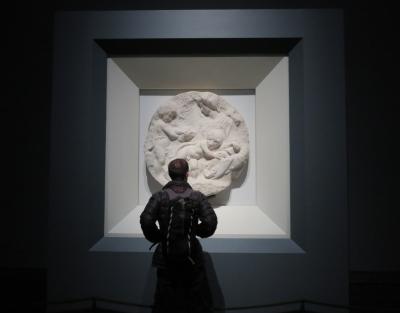
Michelangelo (1475-1564) The Virgin and Child with the Infant Saint John the Baptist (‘The Taddei Tondo’), about 1504-1505. The virgin caresses the young Baptist who offers her Son a fluttering goldfinch, symbolic of Christ’s later suffering. He shies away, but looks back, awakening to his fate. While his facial expression is neutral, as in a classical sculpture, his dynamically posed body, inspired by Leonardo, is distinctly expressive. The relief is probably unfinished, but the varying levels of completion and texturing are at least partially intentional, typical of Michelangelo’s developing aesthetic at the time. This tondo (roundel) is named after the Florentine patron, Taddeo Taddei, for whom it was made. (Museum description of the piece).


Close up of The Virgin and Child with the Infant Saint John the Baptist (‘The Taddei Tondo’)k, about 1504-1505.


Vincent van Gogh (1853-1890). Sunflowers, 1888. Van Gogh associated the colour yellow with hope and friendship. He suggested that his four Sunflowers canvases, painted to decorate his house in Arles, express an ‘idea of symbolising gratitude’. He seems to have been especially pleased with this picture, which he hung in the guest bedroom in anticipation of the arrival of his friend, the artist Paul Gauguin.


Leonardo da Vinci (1452-1519). The Burlington House Cartoon, about 1499-1500. The Virgin sits on the lap of her mother, Saint Anne. The Christ child blesses his cousin Saint John the Baptist. This large drawing is a cartoon: a life-size preparatory study for a painting. In order to transfer a design onto a panel, the outlines of cartoons were usually pricked or incised. This is not the case here, as the drawing remains intact. It must have been preserved in its own right as a finished work, although some areas are deliberately left inconclusive. Leonardo exhibited a cartoon of the subject in Florence in 1501, making a profound impression on Michelangelo who responded in his Taddei Tondo. The design of that lost cartoon is probably preserved in Leonardo’s painting of the subject in the Lourve. (Museum description of the piece).


Leonardo da Vinci (1452-1519). The Virgin of the Rocks, about 1491/2-0 and 1506-8. The Christ Child, at right supported by an angel, blesses his cousin, the infant Saint John the Baptist, who folds his hands in prayer. The Virgin connects the two by holding out one hand above her Son, while touching John’s shoulder with another. Leonardo’s sophisticated rendering of figurines interacting in three-dimensional space was ground-breaking and became crucial for Raphael. The theme of the painting is the doctrine of the immaculate Conception, which entailed the belief that though born of human parents, Mary was preserved from original sin. Her serene beauty and the carefully studied primordial setting, untouched by human hands, emphasizes her purity and role as intermediary for Mankind. (Museum description of the piece).


Raphael (1483-1520). The Ansidei Madonna, 1505. Raphael painted this altarpiece for the chapel of the Ansidei family in the church of San Fiorenzo in Perugia. Responding to the challenge of its restricted setting, Raphael was inspired to produce on of the most imposing and resolved altarpieces of his early career. The Virgin is flanked by Nicholas of Bari and John the Baptist, name saints of the patron and his son. The Baptist gazes up at his slender crystal cross and points towards Christ, foreseeing his passion. The altarpiece’s division into harmonious thirds is the result of careful geometrical planning. Surprisingly, however, the lofty vaulted architecture was an afterthought, added when the painting was well advanced. The brilliance of Raphael’s solution was to create the illusion of a chapel-like space where none may have existed.

The British Museum

Our Airbnb host Errol, on the British Museum:

“They’ll ask for a donation but I don’t give them a thing. It’s just a bunch of stuff that’s been nicked from other countries.”

It’s true. British archaeologists have scoured the globe and brought back roughly 8 million beautiful and important artifacts from civilizations worldwide. Is it ethical? We think it depends. On one hand, it seems a shame to rob countries of their history. On the other hand, we’ve seen museums in developing or unstable countries (e.g. Egypt and Cuba) store uncurated collections of important artifacts in non-climate-controlled rooms, direct sunlight, or even outdoors. In that case, the British Museum’s impeccable preservation and curation doesn’t sound so bad.

We were unable to see all of the museum in an afternoon, as you can imagine, but we did make a point to hit the museum Director’s top highlights, including the Rosetta Stone.


The interior of the museum.


The Rosetta Stone was discovered in mid-July 1799 by soldiers in Napoleon’s invading army at the town of Rashid (Rosetta), and later surrendered to the British as part of the Treaty of Alexandria in 1801. Copies of it were circulated internationally and within 25 years, the hieroglyphic script was deciphered. I had been dreaming of seeing this stone since the 6th grade.


The Royal Game of Ur, 2600-2300 BC, modern day Iraq. At least six graves in the Royal Cemetery contained a wooden game board inlaid with shell, red limestone and lapis lazuli for the game now known as the Royal Game of Ur. This is an early example of a game that was played all over the ancient Near East for about 3000 years. (Museum description).


Pair of gold armlets, 5th-4th century BC, Oxus Treasure. These objects are among the most important surviving items of ancient Persian craftsmanship. It is likely that they were intended for display rather than being worn. The lion-griffin terminals were originally inlaid with precious stones, which were later removed. This inlay is typical of high-quality jewllery from this period. Similar armlets are shown on the sculptures at Persepolis, presented as royal gifts by the Lydian delegation. (Museum description).


Palace of Sargon. These are sculptures from the city and palace of Korsabad, built for the Assyrian king Sargon II (721-705 BC). The pair of human-headed winged bulls stood originally at one of the gates of the citadel, as magic guardians against misfortune. (Museum description).


Basalt statue known as Hoa Hakananai’a (Probably ‘Stolen or hidden friend’), Easter Island, Chile, 1000-1200 AD. This Statue, representing an ancestral figure, was possibly first displayed in the open air. It was later moved into a stone house at Orongo, the center of a birdman cult. Low-relief designs carved on the back are associated with this cult. The statue seems to have been used in both context to express ideas about leadership and authority.


The Holy Thorn Reliquary. Enamelled gold, sapphires, rubies, and pearls. Paris, ~1400. This reliquary was made to contain a thorn, supposedly from the Crown of Thorns that was placed on Christ’s head before the Crucifixion. The armorial enamelled plaques in the base show that it was made for Jean. duc de Berry (1340-1416. The Crown of Thorns itself was a French royal relic, housed in its own chapel in Paris. Individual thorns were detached to make precious reliquary jewels.


The British Museum houses a collection of statues taken from the Parthenon in Athens, which was built 2,500 years ago as a temple dedicated to the Greek goddess Athena. There is a bit of controversy surrounding these statues. Mainly, Greece would like them back. The heads of many statues live in Athens, while the bodies are in London, and it does seem a shame that they can’t work together to unite them once again.


The Nereid Monument. Built by Lykians, a civilization living in modern-day Turkey which was eventually assimilated into Persian and then the Athenian empire. This is the finest and largest example of a Lykian tomb found at Xanthos, southwest Turkey. It is named after the figures of Nereids, daughters of the sea-god Nereus, placed between the columns. It reflects both Greek and Persian influences on Lykian culture. The high podium burial style was Persian, while the architecture is clearly Greek.

London Walking Tour – Part III

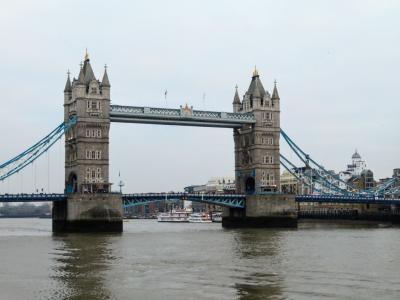
The third and final portion of our London Walking Tour took us from the Tower Hill tube stop past a remnant of the London Wall, The London Tower, Tower Bridge, London Bridge, and All Hallows By The Tower, arguably the oldest church in London.

Stop 13: London Wall

This is one of the most impressive surviving sections of London’s former city wall. The lower part was built by the Romans around 200AD. It’s purpose may have been as much to control the passage of goods and people as for defense. During the medieval period, the wall was repaired and heightened. From the 17th century it fell into disuse and parts were demolished. Several sections, including this one, were preserved by being incorporated into later buildings.


Statue believed to be of the Roman emperor Trajan, AD 98-117.


Stop 14: The Tower of London

Stop 15: Tower Bridge

The Tower Bridge, completed in 1894, is a London icon.


Stop 16: London Bridge

London Bridge is… just a bridge. And it appears to be quite sturdy. (It’s shown in the background of this photo). Still, we felt a need to see the thing we all sang about as children.


Stop 17: All Hallows At the Tower

All Hallows at the Tower is arguably the oldest church in London. Part of the structure dates back to the time of the Saxons in 675 AD, and the crypt contains a Roman tessellated floor dating from the 2nd century. It was extensively damaged during the blitz in WWII and later rebuilt.


The crypt and chapel below is rather spooky.


The crypt below houses the remains of people who were involved in the church, including Tubby Clayton and Sir Thomas Moore. The altar is interesting from a Knights of the Templar holdout in Palestine, dating back to the times of the crusades. It was gifted to the church in 1945 by Miss Frances E. Newton, a “formidable, pipe-smoking missionary working in Palestine supporting Arab causes since 1889”.


This one threw us for a loop. This was once the crow’s nest used by Shackleton on his last Antarctic expedition in the good ship “Quest”. It was set out during church fundraisers to be filled with donations. It’s presence in the church doesn’t make much sense and how it got there is apparently a bit of a mystery.

How to eat cheaply in England

England is not a cheap vacation destination by any stretch of the imagination, (especially when compared to Cuba or Mexico City).

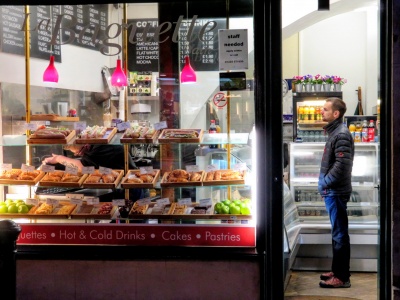
We did figure out one good trick to save money, however: hand pies. Hand pies are a cheap (<$2) alternative to sit-down food and can be carried with you as you move along the city quite easily. They can be filled with cheese, meat, vegetables, pesto… basically anything that can be folded into pastry. I can’t promise that they will be delicious, frankly. But they will sustain you for your London walking tour. You can find them in grocery stores, bakeries, and pastry and pie shops. The cheapest and tastiest we had actually came from the local grocery market, so don’t think that a fancy shop means a better pie.

Add in a water bottle, good camera, and tripod and you’re ready to hit Parliament Street!

Josh waits patiently for our hand pies to be heated in Bath, England.


Other cheap food options include:

  • Pizza (make sure to order cheese on your pizza, otherwise you might accidentally end up with marinara bread like we did), and
  • Cooking breakfast in your Airbnb kitchen. We had English breakfast tea, toast, and eggs every day thanks to our gracious Airbnb host*.

(*For more info on how to use Airbnb to live with a local in another country, and a $40 off coupon, click here.)

Hampton Court Palace is a really spooky place

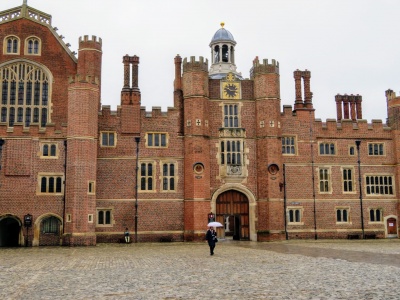
Rain seemed fitting for our visit to Hampton court palace: a dreary day for a dreary place. One of the halls echoes with the sound of a child whispering the fates of the wives of King Henry VIII; “Divorced, beheaded died; divorced, beheaded, survived”. Most everything about the castle was creepy, unwelcoming, and a little bit off.

Entering the palace the same way courtiers would when seeking an audience with the king, we found this waiting room. In the time of the king, there was no number to take and no line to stand in, just a room to stand and wait as long as it took. The king may not choose to conduct business for days at a time but his pages would sometimes emerge from their hidden corridors through a slit in the tapestries.

At least they would have this incredible ceiling to look at while they waited.

We next walked down a hall that didn’t photograph well, but had an interesting story. King Henry’s fifth wife, Catherine Howard, was beheaded at the Tower in 1542, aged 19, for adultery and treason. It is claimed that after she was arrested at Hampton Court, the terrified teenager broke free of her guards. She ran along what is now called the Haunted Gallery, screaming out to the King for mercy. She never reached Henry, but may have gotten about as far as this painting:

King Henry VII’s portrait of his family did not include his living wife, but rather his dead third wife, Jane Seymore, and his son Prince Edward. It also included two court “fools”, (not pictured), who were likely people with learning disabilities, and who were regarded as God’s special children and being closer to nature than other people.


In this painting, the four writers of the Gospels are crushing the Pope with rocks. Yes, really. Back story: In 1534 Henry VIII declared himself Supreme Head of the Church of England. He believed that he had direct and privileged access to God. The Pope was therefore unnecessary. Henry justified this through his reading of the Bible, as we can see in this brutal painting that Henry commissioned and owned.


As we proceed deeper into the castle, the rooms got progressively more exclusive. the private areas reserved for the royal family and their personal guests were ornately decorated. the corners were rounded out, providing a smooth surface for continuous murals to surround the room, like the photo below demonstrates.

Card and conversation room for hosting guests of the Royal family.


Mirror selfie in the throne room. So 16th century.


The most private room that we viewed was the Queen’s living quarters. It was dark, both in terms of light and decor. This was the place where the Queen could escape the expectations of her station and come to relax, even away from the watching eye of Henry VIII.

After spending time in the dark and spooky inner castle, we were happy to take a walk outside down the narrow alleys of the palace village before we caught our bus to Stonehenge!


Beautiful Bath, England

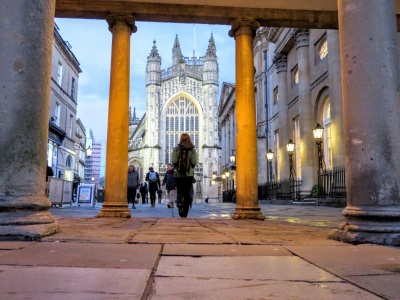
Nicole strolls toward the historic Bath Abbey.


Bath is a beautiful city. Its architecture and history asked for more time than the few hours we had to give, but we were glad to have the opportunity to walk centuries old stone streets, enjoy beautiful 18th century golden limestone architecture, and explore a 2000-year-old Roman bath house. Many of the streets are lined on either side with stone columns supporting long, golden apartment buildings a dozen feet overhead. This ever-present, smooth, honey-colored limestone came from local quarries and is only found here. The clean, geometric layout of roads and consistent styling of the buildings is beautiful by design, owing to city plans laid out as early as 1754. If you find yourself near Bath, it’s well worth whatever time you can spare.

Romans flocked to Bath after the discovery of a thermal hot spring below the town. They built a beautiful bath house, for which the town is named, complete with hot rooms, cold rooms, steam rooms, oiling rooms, and this large, heated swimming pool. In the time of the Romans, this would have been fully enclosed with a lofty ceiling above the second floor.


The water in the main pool is now tinted green with algae. Unfortunately, it is laced with heavy metals, teeming with bacteria, and is now unsafe to touch. This photo also shows how the baths have been reconstructed. The floors and bottom few feet of the columns are original while the lighter bits above were rebuilt in modern times.


Josh waits to order at a pastry shop just around the corner from the bathhouse.


The streets were absolutely beautiful. Some of the romantic imagery Jane Austen describes in her novels was inspired by her time living here.


Nicole drinks the (purified) “healing” waters. It tasted like metal.


Stonehenge

I have wanted to go to Stonehenge ever since I was a little girl and read a book called Circle of Stones. Thinking back, that book probably wasn’t appropriate for a little girl, and it had very little to do with Stonehenge, but it sparked an interest in me that has grown over the years. I love the mystery and sacredness of prehistoric monuments, goddess figurines, and temples built out of stone. It’s my thing.

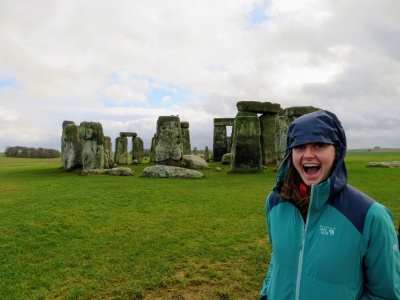
So, when I finally got to approach the big stones in person, this was me:

You’d have to ask Josh, but I’m pretty sure there was literal squealing.


I was probably pretty annoying the entire day because of my barely contained excitement. It rained cats and dogs on the bus ride there and I worried all day that we wouldn’t be able to enjoy our visit. But we managed to catch this brilliant gap between the raindrops that provided a variety of lighting conditions for practicing our photography skills. This one was among my favorite shots:

The crows that live at Stonehenge are mesmerizing. They float over the circle and periodically land to and caw to give an eerie feeling to the area. Especially with the brooding clouds, it was an amazing sight. (Photo taken with our Canon PowerShot SX730.)


Birds and plants, and lichens make themselves at home among the stones. The featured Trilithon is grooved so the stones fit together without rolling off and was hoisted up several meters to be placed there. And they built this all with sticks and stone tools! Amazing.


Reconstructed prehistoric dwelling for this region. The people who built Stonehenge would have likely lived in something like this.

I loved this photo of Josh.
Overall, our visit to Stonehenge was very satisfying and well worth the trip. I would highly recommend it to anyone considering a trip to London.