How Bogota Feels

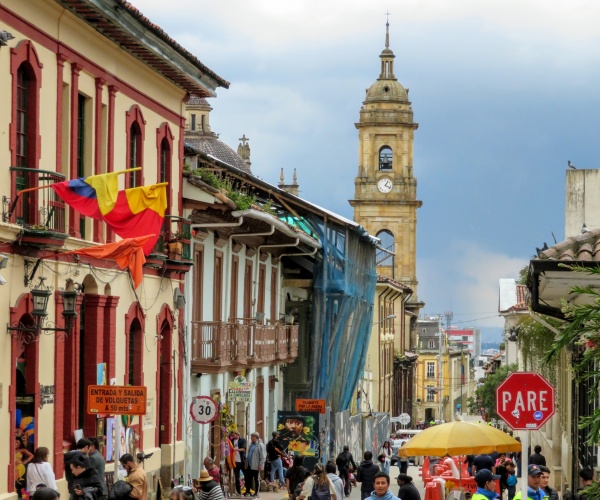
This is what Bogota feels like:

It’s colorful, crowded, bustling, and full. Full of life, art, mountain views, varied architecture, fruit, and unexpected weather. I loved it. This post is just a set of pictures from around the city that capture that feeling fairly well.

New and old architecture stand side-by-side.


Festival atmosphere on Bolivar Square with the Cathedral in the background.


Josh walks down a narrow, colorful street.


Churches and street art and strays.


This traffic circle and ridiculously colorful pair of buildings were a block from our Airbnb.


Pigeons take flight in Journalist’s Park.


The Best Layover: The Everglades

We got global entry recently, which allows us to scoot through security in an average of 1-2 minutes and has dramatically reduced the amount of time we spend going through airports. We highly recommend it. So when we had a long layover in Fort Lauderdale, we felt much more secure leaving the airport to see some sights, knowing we could get back in very quickly.

The plan was this: Get in at 5am, rent a car, drive to the Everglades for a sunrise hike, take a boat ride, visit the Miccosukee Indian Village, and be back in time for our flight to Jamaica. It went flawlessly.


This was our first time visiting Everglades National Park!


We hiked into the park before it opened and were rewarded with a slow sunrise show with a chorus of birds, bugs, and alligator bellows.


This beautiful hawk was chowing down on a crayfish breakfast.


Awww…. We thought the grandmas would like this one.


Note to self: Come back with a kayak.


Next up: Air boat ride!


Josh and an alligator. …Not scary.


Lazy swimmer.


They aren’t exactly photogenic creatures.


Miccosukee Indian Village. It looks to me that this guy is punching that alligator. Just saying.


Look at this handsome specimen! The grasshopper is okay, too.

3 days in Jamaica

Total Trip Time: 4 days (2 weekend days + 2 days PTO)

Major Attractions Visited:

  1. The Everglades (Layover at Ft. Lauderdale, Florida)
  2. Downtown Montego Bay
  3. Luminous Lagoon (Bioluminescent Bay) in Falmouth
  4. Doctor’s Cave Beach
  5. Greenwood Great House
  6. Mobay Kotch


The plan was this: Get in at 5am, rent a car, drive to the Everglades for a sunrise hike, take
There’s a city-wide 8pm curfew and state of emergency called in response to a high number of gang-related homicides.
Built in the 1760s, this beautiful building has had many lives. Most recently, it was our temporary home (and inspiration
It was one of the coolest things we've seen in this world.
The Greenwood Great House was one of the only plantation homes to survive the Christmas Rebellion of 1831.
“Parents will go without, but Jamaicans take great pride in getting their children to school every day in a crisp,
Climate change and overfishing have decimated the Jamaican reef and turned it into a bleached, algae-covered mess. Still, we managed

The Best Layover: The Everglades

We got global entry recently, which allows us to scoot through security in an average of 1-2 minutes and has dramatically reduced the amount of time we spend going through airports. We highly recommend it. So when we had a long layover in Fort Lauderdale, we felt much more secure leaving the airport to see some sights, knowing we could get back in very quickly.

The plan was this: Get in at 5am, rent a car, drive to the Everglades for a sunrise hike, take a boat ride, visit the Miccosukee Indian Village, and be back in time for our flight to Jamaica. It went flawlessly.


This was our first time visiting Everglades National Park!


We hiked into the park before it opened and were rewarded with a slow sunrise show with a chorus of birds, bugs, and alligator bellows.


This beautiful hawk was chowing down on a crayfish breakfast.


Awww…. We thought the grandmas would like this one.


Note to self: Come back with a kayak.


Next up: Air boat ride!


Josh and an alligator. …Not scary.


Lazy swimmer.


They aren’t exactly photogenic creatures.


Miccosukee Indian Village. It looks to me that this guy is punching that alligator. Just saying.


Look at this handsome specimen! The grasshopper is okay, too.

Montego Bay Has a Curfew (But it’s largely ignored)

There’s a city-wide 8pm curfew and state of emergency called in response to a high number of gang-related homicides in Montego Bay. Getting in and out of the city requires going through military checkpoints, but I can’t say we saw much police or military overall. Mostly, we saw a lot of private security. Poverty, homelessness, and mental illness are highly visible and striking.

Here was the view out of the window after curfew:

The Mobay Kotch is a Hidden Gem

If you read the travel.state.gov page about Jamaica, they will mention a few places you shouldn’t go in Montego Bay: Clark Street, Claver’s Street, Church Street, etc. We stayed at the intersection of Clark and Claver’s.

Here’s why:


Built in the 1760s, this beautiful building has had many lives. It has been a Church manse, synagogue, a hotel, a masonic lodge, an office space, and a restaurant, to name a few. Today, it is a registered historic heritage site and hostel called Mobay Kotch, which we were lucky to call home for a few nights.

Although it was located in a rough part of town, the walled yard created a quiet refuge to decompress after exploring and the second story balcony was perfect for calming travel jitters.


Plus, the gorgeous Georgian architecture inspired this kind of annoyingly cute porch photo.


It glows! Swimming in a Bioluminescent Bay in Jamaica

I vividly remember the first time I learned about bioluminescent bays. I was sitting in the second row in Biodiversity 21 at Duke, and professor Paul Manos described the tiny dinoflagellate organisms that get so pissed off when agitated that they glow a blue-green color. (Okay, that’s an anthropomorphism. But the concept is still there.) The point is I remember thinking “Wow. That’s something I need to see before I die”.

I couldn’t believe my luck when a year later I won a grant to do research in Puerto Rico, near one of the 5 major bays in the world where this happens. And then science happened, and we were busy chasing lizards and discovering new weevil species, and I never got to go.

It would be another 8 years before I would be near another bioluminescent bay again, this time in Jamaica, and I was absolutely NOT going to miss this opportunity a second time.

Fortunately, our Airbnb had a local hookup and got us in touch with someone with a boat, who brought us out to the middle of glistening waters bay.


As we moved away from the dock, the motor of the boat caused a blue avatar wake behind us. Fish darted away from the bow in front of us, each of them drawing an illuminated streak across the black water. It was a lot like watching for shooting stars, except they were every foot or so, and in the down direction. The boat driver anchored us at the darkest possible part of the bay, far from the lights of he town, and we climbed down the ladder and slid into the warm, mucky-bottomed water for a swim. Everywhere we kicked and splashed lit up like broken glow sticks in a cotton candy blue. If you stood still, you could almost be invisible. But the moment you moved it blew your cover.

We played like kids and it was magnificent.


These bays are in danger from pollution, storms, and global warming. Hurricane Maria damaged the one in Puerto Rico and it’s unclear whether it will recover. If you have the means, I urge you to go see this phenomenon sooner, rather than later. It is one of the coolest things we’ve seen in this world.

The Greenwood Great House

On Christmas of 1831, a man named Sam Sharpe lead a slave rebellion that spread throughout Jamaica. Plantation owners fled and most of the great plantation houses were looted and burned to the ground. Only a very few great houses were not destroyed, and Greenwood was one of them.

Greenwood Great House


Why were some plantations spared? It is said that if a house survived the rebellion, it is because the owners were kind to their slaves. Greenwood Great House was the estate of Hersey Barrett, who was one of the only plantation owners in Jamaica known to educate his slaves. He reportedly gave them rest, good healthcare, and treated them kindly. The fact that his house remains to this day with the original furniture, books, maps, and treasures in tact may be proof of that.


The house had magnificent jungle-like gardens.


The man who owns this collection is black. I wonder what it must be like for a black man to own a whip that was once used to discipline slaves? I couldn’t imagine living in a house where this hangs on the wall.


This is a man trap. It would be laid between the bushes and camouflaged with branches in pathways that were likely to be used if a slave tried to escape. If triggered, it partially or entirely removed his or her foot.


A courtship couch, meant to preserve chastity between a girl and her suitor. Those Victorians really had some funny ideas about propriety.


Many of the Great House’s musical instruments still played, like this Polyphone. You can enjoy a bit of the music below.

Observations on Schools in Jamaica

One local told us:

“Parents will go without, but Jamaicans take great pride in getting their children to school every day in a crisp, clean uniform”.

From what we saw, that was largely true. 

The streets felt safest just before and after school time, when parents were shuttling their uniformed children to class and older children walked in groups. We took advantage of this time to walk around and explore the city and feel just a little more secure.


Schools were also beautifully decorated and generally well kept.


This schoolyard was decorated with inspirational Jamaicans throughout history.


We also had the privilege of seeing Usain Bolt’s school, where the track around the field was interestingly dirt. Unfortunately we didn’t get a photograph.

Snorkeling Doctor’s Cave

Jamaica abounds with expensive, private beaches full fancy, rich people at resorts. We didn’t go to one of those. The alternative was local beaches, where even locals warned us not to go. We didn’t go to one of those, either. Doctor’s Cave was somewhere in the middle. Here, we were able to pay a small fee to gain entrance to the beach and leave our things in the sand so we could snorkel without worrying about whether or not they would walk away. The beach was nice but the snorkeling was unfortunately unremarkable. Climate change and overfishing have decimated the Jamaican reef and turned it into a bleached, algae-covered mess. Still, we managed to see a few neat fish and corals, and at least the water was warm.
When I flip you flip we flip.


Urchins. Beautiful, painful, sometimes destructive.


Bleached corals.


Here fishy fishy…