There are two cool things to see in the Salt Cathedral in Zipaquirá: the reflecting pond and the chandeliers made of salt. It was an overpriced and underwhelming unofficial church in an old salt mine, and they played Ave Maria on loop, which got old around the 17th time. But I guess the pictures came out okay.
We found our way to this touristy spot using public transit in true Latin American style, by responding to a person yelling “Zipa Zipa” and climbing aboard their less-than-safe-looking bus. Then we spent an hour watching the city slowly fade into sleepy countryside.
Once we reached the heart of Zipaquirá, we traveled on foot to the Cathedral through the pedestrian walkway and town square.
Zipa square was quaint, with pigeons, couples holding hands, and grandfathers shooting the breeze on benches.
Outside the cathedral, Zipa had other touristy things, like zip lines and an impressive climbing wall with no actual routes that we could see.
They could use a setter.
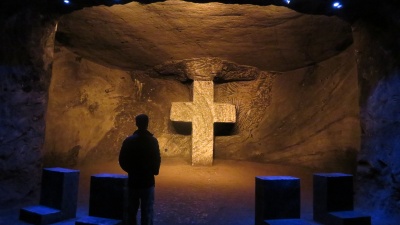
The Cathedral has a walkway with stations of the cross and 4 large chapels, built into old mining tunnels.
Josh in the nicely lit 6th or 7th station of the cross.
Believe it or not, this is not a color-adjusted photo. There was rather spooky lighting at this station.
This was the highly saline reflecting pool that is only a few inches deep. The ripples seemed to travel very slowly, which was highly entertaining.
There were several marble sculptures in the mine, imported from Italy and completed by an Italian artist. The style clashed with the rough work of the miners and it seemed a shame to not feature a national, but at least this one cast a nice shadow.
The artist also made this salt carving with local children. Cooler!
These chandeliers were about two meters across and were carved entirely out of salt. This was probably the most impressive thing about the cathedral.
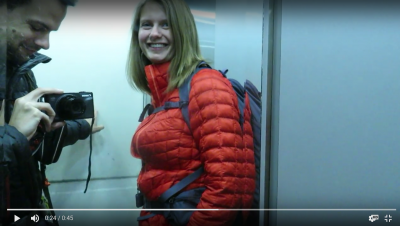
Blurry main cathedral selfie. It was cool enough to go once… But not to revisit.
Okay, maybe I made that word up. But I needed a term for a particular phenomenon many of you have probably experienced: the warm, fuzzy feeling of eating a familiar food that you haven’t had in a very long time. Anyone who went to a far away school, moved to a different state, or lived abroad knows what I’m talking about.
For me, visiting the Andes again was all about gastronostalgia, and instead of my usual densely-packed list of potential things to see and places to visit, I went there with a list of foods 2 pages long that I wanted to eat.
By the time I left Ecuador, I thought I never wanted to eat a watery potato and cilantro soup ever again. I was wrong. It still isn’t very delicious, but it tasted inexplicably like coming home. The bits in the middle are fried unripe plantain bowls with a sweet tomato sauce, and the bit on the left is chicken and tomato sauce.
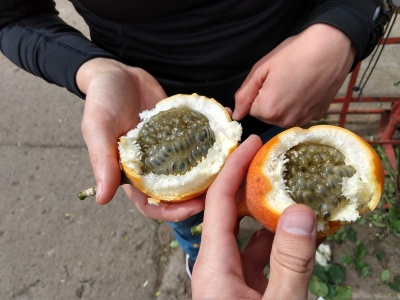
Granadilla is the perfect street food. You buy it for a few cents, crack it open, and suck out the sweet, juicy, refreshing, somewhat crunchy goodness. Don’t mind the fact that it looks like salamander eggs and the texture is kind of like a slimey pile of sunflower seeds. The flavor is worth it. Incidentally, this is a variety of passion fruit, which is Josh’s favorite juice. I was excited to share this experience with him so he could try the real thing.
Me with a teeny cup of coffee on the main square.
Arepa burger + extremely tasty thing I can’t remember. Choclo (a large mesoamerican corn variety), quail eggs, meat, cheese, and shoestring fries.
This is not an ice cream sundae. It is a heap of shredded cheese, heavy cream, and mixed fruits. There’s 1 small scoop of the icy stuff in there that seems to be fruit cake flavored. It was good.
The variety of fruits in South America is phenomenal. Top 3 fruits: Lulo (naranjilla), granadilla (passionfruit), tomate de arbol (tree tomato). Middle fruits: Granadilla, slices of lulo, mangostina (mangosteen), red tomate de arbol. Bottom fruit: opened mangostina
Just an entire store for avocados… or a front? We couldn’t decide.
This cheese-filled fried dough and meat on a stick was probably the best food we ate in Colombia. Unfortunately, it was actually Venezuelan.
Coca leaves, the unprocessed plant form of cocaine, is highly criminalized in the US and completely legal to possess in Colombia. Andeans across Peru, Ecuador, Colombia and Bolivia have been chewing coca leaves or drinking coca tea for thousands of years to help alleviate pain, suppress appetite, and treat altitude sickness.
We had to try it.
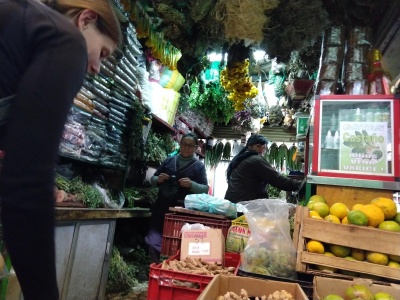
Wonderful little herb shop in Paloquemao, and helpful grandma.
First, she recommended that we mamar (suck and gently chew) the dehydrated leaves instead of fresh ones because dehydrated is a bit stronger and will keep well for our travels. Second, she recommended that we take a few seeds of cardamom for flavor. And third, she recommended that we use something to release the active ingredient to get the full effect. She likes to use wine, but unfortunately Colombia is dry for elections, (more on that in another article), and we couldn’t get alcohol. Many people will use limestone. We went with Tums.
Cardamom, tums, and coca.
Immediately upon putting the dry leaves in our cheeks and gently mashing it into a ball with our molars, it became clear that this experience is NOT about the flavor. It tasted a little like hay smells. But the cardamom helped make it much sweeter and more enjoyable. (Grandmother was wise.) To increase the release of cocaine, we chewed in small bits of antacids in intervals.
Cocaine ingested in this form is a slow, pleasant, mild stimulant. We first noticed that our cheeks were numb- that’s how you know it’s working. After some time, we noticed our hearts beating faster and a slight increase in our breathing. And I was in a pretty great mood. We found that the tea had a slightly stronger effect.
Overall, it’s not something I would do every day, but it’s an experience I’m very glad we had.
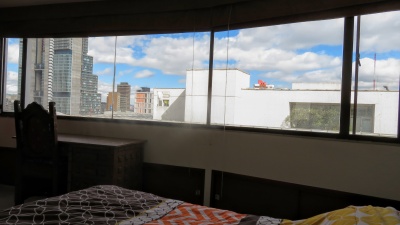
When we’re in dense cities we feel unsure about, we try to find an Airbnb on as high a floor as possible. It helps my introverted self to calm down after a day of peopling and can fake a sense of calm and peacefulness in an otherwise noisy, bustling city. This trip was no exception and Yvette and Jason’s place did not disappoint.
It’s colorful, crowded, bustling, and full. Full of life, art, mountain views, varied architecture, fruit, and unexpected weather. I loved it. This post is just a set of pictures from around the city that capture that feeling fairly well.
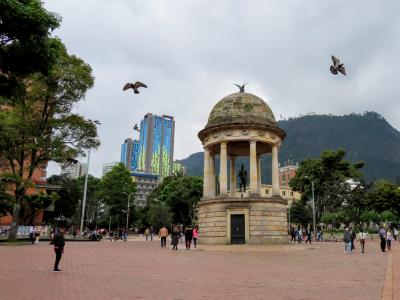
New and old architecture stand side-by-side.
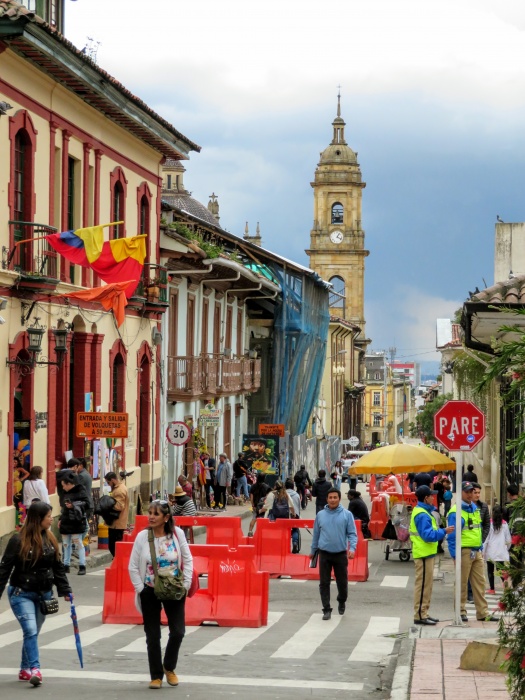
Festival atmosphere on Bolivar Square with the Cathedral in the background.
Josh walks down a narrow, colorful street.
Churches and street art and strays.
This traffic circle and ridiculously colorful pair of buildings were a block from our Airbnb.
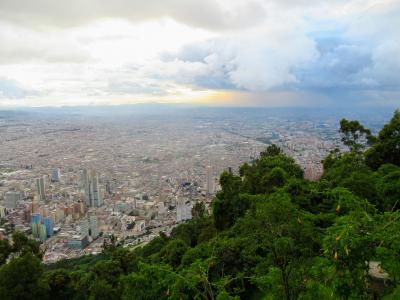
The monastery-topped mountain Monseratte looms over the East horizon of Bogota. A teleferique and train run to the top to deliver tourists to the 10,000 foot peak with beautiful views of the city. We scurried up to the top on a rainy afternoon, successfully dodging both crowds and raindrops.
The monastery.
Spectacular rainstorm and views of the city.
Familiar faces.
The isolated showers were stunning.
As was this quaint mountain cottage.
The cloud forest in the Andes is known for many varied species of hummingbirds, like this little guy who joined us on the mountain.
One of our favorite things to do in any new country is to visit a local market. Paloquemao, a gigantic, pungent, colorful, bountiful market in the middle of Bogota, did not disappoint. There were pyramids of fruit, flowers, herbs, teas, dry goods, eggs, meats, supplements, home goods, and everything you could need. No price tags, no shopping carts, just bartering for what you could carry out in your hands. It was magnificent.
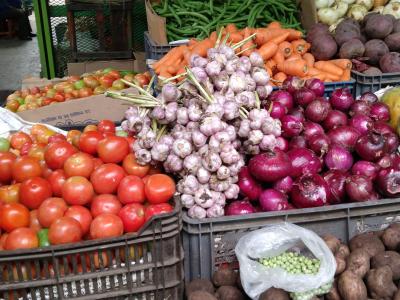
Potatoes and root vegetables in the Andes are incredibly varied. In the US, we see maybe 6 varieties of potatoes on a regular basis. There, there are literally 4,000 different varieties. I couldn’t tell you what kind these are, but they’re sure colorful.
Purple garlic, (for mom), and stubby carrots.
Mangosteen!
Unexpected find… in case you’re wondering, this does not have a smell.
Pretty flowers (for Joanna).
A type of guanabana or soursop! I love this fruit and it is so difficult to get it in the US.
The gold museum in Bogota was one of the shinier places we’ve ever been. It contained 55,000 artifacts from the surrounding countryside, almost all of which was gold. Overall, the museum had nice artifacts but only medium-quality curation. It didn’t change our lives or world views. But it was worth a visit.
Impressive ceremonial dress. Those ear gauges looked seriously painful. And Nicole complains about high heels!? The traditional dedication to physical appearance was extreme. Interestingly, this seems to have persisted, even now in the common era. Colombia has a high rate of cosmetic surgery and even the prostitutes we saw in the red light district had been physically enhanced in several ways. Anyway. Back to gold.
You’ve probably heard the words “El Dorado”, but do you know the story? Legend has it, each time a new leader of the Muisca people came into power, he would cover himself in gold flecks throw gold and precious jewels into lake Guatavita, a nearby body of water as an offering. When the Spaniards came, they called the figure “El Dorado”, or the golden one. Over time, El Dorado shifted in meaning to refer to a source of great wealth in the interior of South America. Crazy with gold fever, the Spaniards attempted to drain Lake Guatavita in 1545. They did not, however, find their fabulous treasure.
Nicole admires Muisca breastplates, some of which were made for women leaders.
Amazing earrings.
I unfortunately can’t remember what this sacrificial burial exhibit said, but it was pleasantly spooky.
This last one is kind of strange. I’m pretty sure they just had more gold than they knew what to do with, so they created this wall of gold things and added sounds and lights to make it interesting.
Growing up, we were taught that graffiti is bad. Tagging was destruction of property, writing was low-class, anything spray painted was done by vandals. The Bogota Graffiti Tour turned that worldview upside down.
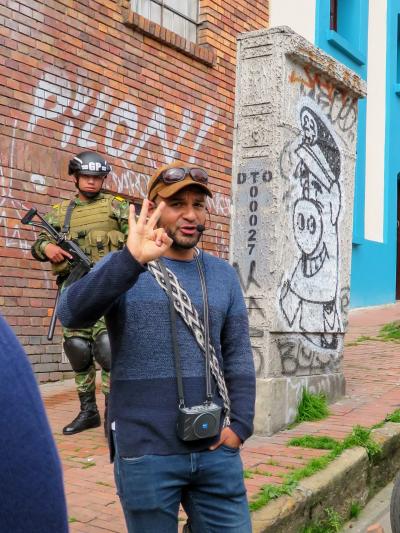
Our tour guide, Jeff, is an anthropology professor at the National University of Colombia and he gave an amazing, free, 3-hour tour of the local street art. He was personally connected to many artists in the Bogota graffiti community and was able to tell us the background and stories behind many of the works we saw. His definition of Graffiti is: a public work of private expression, legal or illegal, which may be political, personal, or fun in nature. We could not recommend this tour highly enough.
I’d like to start with one of my favorite artists on the tour: Lili Cuca. According to Lili, learning to paint graffiti was one of the best things that she ever did. You see, Bogota is not a particularly safe place for women at night. This is also when most graffiti is painted and because of that, there aren’t many female graffiti artists. When Lili was encouraged to learn to paint, she started bringing her brothers as body guards or only painting in large groups. Eventually, she got more and more comfortable with her ability to take care of herself on the street. She described the experience as empowering. I thought her artwork was, too.
One of my favorites by Lili Cuca.
One of the best moments on the tour was when we stopped here to take a look at this pig cop piece and Jeff told us a story about a police-run prostitution ring directly in front of this policeman. It turns out most police officers don’t speak English in Bogota.
Art and muse.
One really neat aspect of the graffiti culture is collectives, which is a group of artists who join together to paint particularly large works under a single name. This work was done by the APC (Animal Power Culture or Animal Power Collective), and featured over 30 distinct artists. It was done with permission of the owner of the cat-themed coffee shop.
We loved how this piece incorporated the light pole, which was about 6 feet in front of the wall. If anyone reading this remembers the name of this technique, please send us a message!
DJ Lu primarily does stencils and paste ups of portraits of real people from the streets of the city, combined with imagery of war and everyday objects. This piece shows a juice seller, in front of pineapple grenades stencils, a reference to the violence surrounding western fruit import.
In Purple: “I give you oxygen and what do you give me?” In black: “You killed a tree to write this bullshit?”
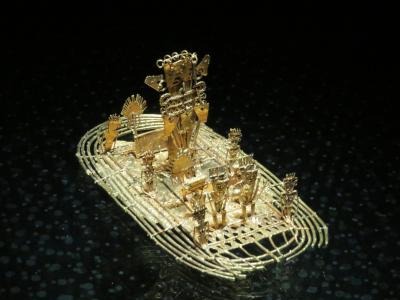
We weren’t particularly impressed by this mural, but do you recognize the raft? This is a portrayal of the Muisca ceremony mentioned in our article on the gold museum, and depicted in a fabulous gold work from that collection. The tag in the middle of this mural is out of character, painted by a “hooligan”. (Technical term). Most taggers are also graffiti artists and respect the work of their peers. Because of that, the most effective way to make sure a tagger doesn’t write on your property is by allowing a mural artist to paint something there.
Lake Guatavita
This was my favorite piece of graffiti writing on the tour. Our guide explained to us that, generally speaking, the more difficult it is to read the letters, the higher-quality the writing. This one was almost illegible when we were standing up next to the wall. Do you see it? (If you look closely, you can make out the word “Cielo”, the name of the artist’s daughter; this piece is a tribute to her.)
Stinkfish has a very distinctive style of decorating faces with these sunburst-like patterns. Interestingly, we saw him on our Google Chromecast street art feed recently and were instantly able to recognize his work.
Bastardilla paints depictions of rural poverty that are primarily sad and dark with glimmers of hope. She painted this one from the ground using extending paint rollers.
The Evolution of the Indigenous people. Another work by the APC.Rodez is a fine arts professor at the local University and father to two young artists. After watching his boys grow up with so much artistic talent, he was heartbroken when they started wasting it on painting graffiti. Eventually, one of them invited him to paint and he went along to see what street art is all about. Rodez was immediately hooked and has been painting graffiti ever since. He created this piece to decorate the wall of a salon in the heart of Candelaria with one of his students.
This next piece was a little heartbreaking. It features a capitalist, carried on the back of an indigenous man, who is clinging to nature in hopes of escape and freedom.
The other side of this mural depicted a mining company, vulture miner, and deluded capitalist.
On a more lighthearted note, this beautiful lion was commissioned by a local restaurant.
The artist who painted this knocked on the door of a stranger’s house and asked the owner of the property if he would mind if he painted his garage. The owner asked him what he wanted to paint, and he showed him a photo of a young boy at a protest for clean water. The owner said “Yes, please paint it as soon as possible. I am so sick of taggers.”
We have so many more photos of graffiti from this tour but these were a few of our favorites. Again, we couldn’t recommend the Bogota Graffiti Tour highly enough.
We were both nervous and excited to be in the Colombian capital on the presidential Election Day. Let me break it down for you:
The progressive candidate was Petro. He campaigned by kissing babies and the elderly, using rainbow fonts and flags, wearing jeans and a button down, and generally appealing to the common man. We saw a pro-Petro rally in the streets and people lining up to hear him speak. The people chanted “Petro, amigo, la gente está contigo”, (translation: Petro, friend, the people are with you!), and “Peeeeeetroooo” in a call and response manner in the streets.
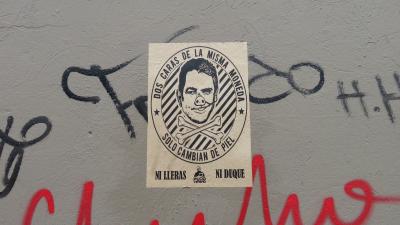
The conservative candidates were Duque and Lleras. Street art contended that these two candidates were two faces of the same coin, and a continuation of the status quo in Colombia. The current presidency was associated with police corruption, (including a police-run prostitution ring where the prostitutes were also police), murdering homeless people and dressing them up like FARC rebels to meet military quotas, budget skimming, and general exploitation of the people. Duque campaigned by wearing suits, posing with wealthy older people with light skin color, focusing on symbols of strength and power, and talking critically of compromise with the FARC. It was widely believed that electing him would risk the progress made that had ended the civil war.
Colombia is dry on election day and it was impossible to get alcohol before or during the time that the polls were open. The locals think it’s nuts that we sell alcohol on election day in the US.
The elections went to a second round with the top 2 candidates, Petro and Duque.
Duque won.
We’ll see what that means for Colombia and the peace treaty as time goes on.
This reads: Two sides of the same coin. Only a change in skin.
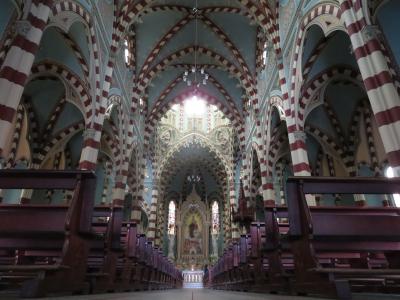
No story here, but Josh flexed his photography muscles on this devastatingly beautiful candy cane cathedral, and I thoght I would share. If you ever get the chance to visit Bogota, don’t miss Nuestra Senora del Carmen.